
Last updated: August 19, 2026
The best real estate APIs in 2026 are five different products doing five different jobs:
- Approved MLS listing data on a single board: Spark API from FBS.
- Broad multi-market reach across many MLSs: Trestle by Cotality.
- Canadian listings: CREA’s REALTOR.ca DDF.
- Property enrichment with no payment step: the U.S. Census Bureau’s American Community Survey and Economic Indicators APIs.
- Publishing licensed listings on WordPress: MLS Import, which is our own product, so weigh that recommendation accordingly.
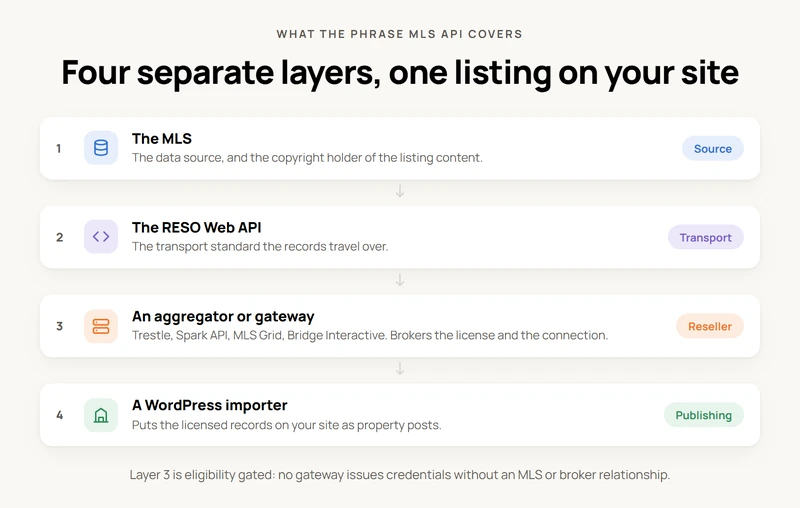
Four separate things hide behind the phrase “MLS API”, and they aren’t interchangeable. The MLS is the data source and the copyright holder of the listing content.
The RESO Web API is the transport standard the records travel over. An aggregator or gateway (Trestle, Spark, MLS Grid, Bridge Interactive) is the reseller layer that brokers the license and the technical connection between you and one or many MLSs. A WordPress importer is the publishing layer that puts the licensed records on your site.
MLS Import is not an MLS data API; it connects an approved RESO Web API or REALTOR.ca DDF feed to WordPress and synchronizes the permitted listings.
One thing to know before you compare anything. Every one of the five listing-data routes below is eligibility gated. None of them sells a production feed of current listings to a developer who has no MLS or broker relationship, at any price.
The five jobs and the real estate API for each
Here is the same set of jobs as a buying decision. Read the eligibility column first, because it decides whether the other six columns matter to you at all. Documentation URLs are printed as plain text so you can paste them into a browser and check them yourself. Every row is a licensed MLS listings API, not a scraper.
| Owner | Geography | Eligibility requirement | Data type | Authentication method | Pricing public | Documentation URL |
|---|---|---|---|---|---|---|
| Trestle by Cotality | Dozens of MLSs across North America | Technology provider account, then per MLS licensing and MLS approval | Listings, media, member and office, open house, tax records | OAuth 2.0 client credentials, bearer token | Yes, fee tiers published | trestle-documentation.corelogic.com/ |
| Spark API (FBS) | US Flexmls boards, multiple MLSs | The MLS sets your role: MLS Member, IDX or VOW | Listings, contacts, market stats | OAuth 2.0, developer plus member authorization | No | sparkplatform.com/ |
| MLS Grid (MLS cooperative) | Participating US MLSs | Subscription, licensee added, then MLS approval | Replication only, mapped to the RESO Data Dictionary | OAuth 2.0, long-lived tokens | No | docs.mlsgrid.com |
| Bridge Interactive (Zillow Group) | Numerous MLSs in the US and Canada | Request access through your own MLS | All MLS resources, optional Zillow public records | RESO Web API over OData | No, fees sit with your data provider | bridgeinteractive.com/ |
| REALTOR.ca DDF (CREA) | Canada | CREA Participants only, brokerage opts in first | MLS listing content, CREA approved fields | DDF username and password issued to the Participant | No | crea.ca/ |
Every cell above was read off the provider’s own documentation and verified on August 19, 2026.
Approved MLS listing data in the United States
All four US gateways gate on a relationship you already hold. Bridge Interactive tells you to “reach out to your local Multiple Listing Service” and request data access. At MLS Grid the token comes last: “Once a subscription has been created, a licensee added, and the MLS has approved”.
Coverage is a separate question from the gateway. Bright MLS, for example, covers the Mid-Atlantic under one feed.
Trestle’s FAQ says MLS organizations “typically require a real estate broker or agent to ratify the contract”. Spark is blunter: “The API only allows access to data by authorized members of the MLS.” All four verified on August 19, 2026. We also compared direct feeds against vendor relationships.
Eligibility is a role, not a license alone. NAR’s qualification policy says Participants must be REALTORS who are “a principal, partner, corporate officer, or branch office manager acting on behalf of a principal”, and must hold a current, valid real estate broker’s license (NAR, verified on August 19, 2026). Listing content is the MLS’s “copyrighted MLS compilation”, and unauthorized use runs through a formal complaint process (NAR Model MLS Rules Section 11).
The transport underneath all of them is the RESO Web API. RESO currently certifies Web API Core 2.0.0, Data Dictionary 2.0 and RESO Common Format (reso.org, verified on August 19, 2026); Data Dictionary 2.1 is still in development (dd.reso.org). Certification comes in three states: Certified Legacy, Passed Current and Certified Current.
RESO states the migration plainly: “Some systems still use the Real Estate Transaction Standard (RETS), but this is a deprecated legacy method of data transport that RESO discontinued certifying in 2018.” Eight years ago. Build on the current standard and nothing else: the mechanics are in our RESO Web API connection details, and the gap between the two is in how the current standard differs from the deprecated one.
Coverage, in RESO’s own words: “At least 90% of MLSs in the industry have RESO-certified Web API services” (RESO certification, verified on August 19, 2026). RESO tracks 489 MLS systems in the U.S. as of July 2026; NAR says “around 500”. Two different counts, published by two different bodies.
Canadian listings and the REALTOR.ca DDF
Canada doesn’t work like the US. CREA runs the Data Distribution Facility and is the sole source of the REALTOR.ca DDF feed, so there is no aggregator market around it to shop.
Access belongs to Participants: participating brokerages, salespersons and franchisors, in CREA’s own vocabulary. The brokerage has to opt in through the DDF Dashboard before its salespeople can take part. Everything below comes from CREA’s DDF Policy and Rules (revised January 2024), the version CREA still links today, verified on August 19, 2026.
The rule that surprises most developers is rule 5.j.iii: “Participants may not share or disclose their DDF® credentials, which includes usernames and passwords required to access the DDF®, to a Technology Provider or any other party.” CREA defines a Technology Provider in rule 1.q: a company that has entered into a data access agreement with CREA to operate a National Pool Website or a Member Website on behalf of a Participant. The Provider works for the Participant, under the Participant’s responsibility, and never holds the credentials.
Rule 5.b sets the cadence: “Participants operating National Pool Websites and Member Websites must refresh their Websites at least once every twenty-four (24) hours.” Listing content that is no longer current after a refresh has to come off the site. Build your sync to clear that bar, not to sit on it.
CREA publishes no price list for DDF. It’s a permission tied to membership, not a metered product with a pricing page. If your build lands on WordPress, our REALTOR.ca DDF plugin guide walks the Canadian setup end to end.
Is there a free real estate or MLS API?
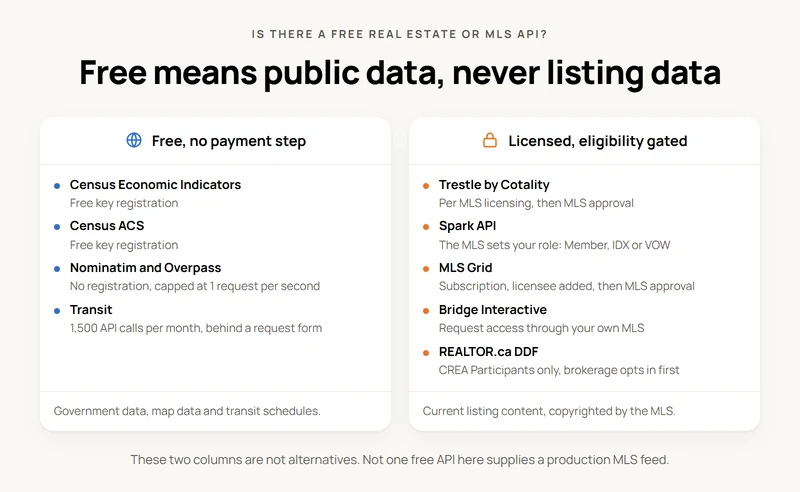
No. Free access to a production feed of current MLS listings does not exist under MLS rules, and the eligibility chain above is the reason: every gateway checks a broker or MLS relationship before it issues a token. Search results for “free real estate API” and “MLS API free” are answering a different question than the one you asked.
The same gap shows up one layer higher, in the plugin market. We went through the free IDX plugins claim by claim to see what each one actually includes.
What’s genuinely free is real, and none of it is listing data. The Census Bureau’s Economic Indicators and American Community Survey APIs are free and key-based (census.gov, verified on August 19, 2026). Neither page publishes a call threshold, so don’t plan around a number you read on somebody’s blog.
The OpenStreetMap Foundation’s public Nominatim instance takes no registration and enforces, in its own words, “an absolute maximum of 1 request per second”, which means production traffic belongs on an instance you host. Transit gives you “1,500 API calls per month for free” on its own partners page, behind a request form.
Scraping isn’t the workaround it looks like. Listing content is the MLS’s copyrighted compilation, and CREA’s DDF rules prohibit scraping outright. You’d be trading a licensing problem for a legal one.
The category error is worth naming: every free API in this research supplies public government data, map data or transit schedules. Not one supplies a production MLS feed.
The MLS API decision table
Before any enrichment API is worth a line of code, decide how the listings themselves arrive. There are two routes to an MLS data API, and they differ on who lets you in, what you can reach and what you are allowed to do with it.
| Direct MLS access, RESO Web API | Gateway or aggregator (Bridge Interactive, MLS Grid, Trestle, Spark) | |
|---|---|---|
| Eligibility | The board approves you. NAR policy says Participants must be REALTORS acting as a principal, partner, corporate officer or branch office manager, holding a current, valid real estate broker’s license. | The same board relationship, one step removed. Bridge tells you to contact your local MLS. MLS Grid issues the token only after a subscription exists, a licensee is added and the MLS approves. Trestle says MLS organizations typically require a broker or agent to ratify the contract. Spark allows access only to authorized members of the MLS. |
| Coverage model | One board at a time. At least 90% of MLSs run RESO-certified Web API services, and RESO tracks 489 MLS systems in the US as of July 2026. | Whatever boards contract with that gateway. The reach is the gateway’s map, not yours, so check your own board against it before you choose. |
| Data rights | Listing content stays the MLS’s copyrighted compilation. Unauthorized use runs through a formal complaint process under NAR’s model rules. | Identical. Routing the data through a gateway does not transfer any rights in it. |
| Pricing model | Quoted by each board. There is no central rate card, so the number comes from your MLS. | Not published. These vendors quote per account rather than list prices on a page. |
| Transport | RESO Web API for both. RESO certifies Web API Core 2.0.0, Data Dictionary 2.0 and RESO Common Format. RETS is deprecated and RESO stopped certifying it in 2018. | |
| Best use case | One market, and a brokerage that already holds its own board membership. | Your board’s data is served through that gateway, or you want one integration shape across several boards that share it. |
Every claim in that table was verified on August 19, 2026, against the sources cited in the sections above.
Property enrichment APIs worth adding in 2026
Of the thirteen enrichment APIs this guide named in its previous version, only four are still free with no payment step. Yelp’s Places API, GreatSchools, Precisely Neighborhoods and First Street have all moved to paid, trial-gated or contact-gated access. Six property data APIs are still worth a place in a 2026 build.
| Owner | Geography | Eligibility requirement | Data type | Authentication method | Pricing public | Documentation URL |
|---|---|---|---|---|---|---|
| Census Economic Indicators (U.S. Census Bureau) | United States | Free key registration | Economic indicator time series | API key | Free | census.gov/ |
| Census ACS (U.S. Census Bureau) | United States | Free key registration | American Community Survey demographics | API key | Free | census.gov/ |
| Nominatim and Overpass (OpenStreetMap Foundation) | Global | None on the public instances | Geocoding and map data | None, capped by policy | Free | operations.osmfoundation.org/ |
| Transit | 1,100 cities in 37 countries | Request form, then an access key | Transit schedules and real-time vehicles | Access key | Free tier stated | transitapp.com/ |
| Walk Score | United States and Canada | Sign-up, free trial, then a key on request | Walk Score, Transit Score, Bike Score | API key | Yes, at walkscore.com/ |
walkscore.com/ |
| Google Maps Platform (Google) | Global | Google Cloud account with billing enabled | Geocoding, places, routes, map tiles | API key | Yes, priced per SKU | developers.google.com/ |
Every row verified against its own documentation on August 19, 2026.
Those four are absent from the table on purpose: none of them is the free addition it used to be.
Two of them changed name as well, which matters if you are following an old link. Risk Factor is now First Street (riskfactor.com redirects there), and Yelp Fusion’s public entry point is now the Yelp Places API.
Realtor Property Resource comes up often enough to answer here: RPR is for REALTOR members only, with no third-party developer access, so there is no key to go hunting for.
Getting listings onto a WordPress site
The publishing layer is the least glamorous piece and the one that decides what your site actually looks like. It takes the records your MLS data API gateway is licensed to send you, writes them into WordPress as property posts, and keeps them current. MLS Import is our plugin, so treat what follows as a disclosed recommendation rather than a neutral one.
It’s $49 per month, or $504 per year, after a 30-day free trial.
One MLS connection per site or plugin setup. If your business needs two different MLS feeds, that means two WordPress installs. There is no configuration that puts two feeds on one site.
The sequence looks like this in practice. Your board issues credentials to the MLS member, not to us, and the member’s own approval is what unlocks the feed. You select the MLS, enter those credentials, choose which fields to import, and build an import task with filters: property type, status, city, county, ZIP, price band, agent or office ID.
The first run pulls the matching listings in bulk. After that, hourly synchronization checks the MLS for changed price, status, description and photos, and off-market statuses such as Closed, Expired and Withdrawn trigger removal. Your theme then displays the results in the IDX format buyers expect.
Two honest limits. Photos are not copied into your media library; they are served from the MLS or its image source, which keeps your database and your backups small but ties your imagery to the board. And a large import needs hosting sized for it, so a dedicated VPS rather than the cheapest shared plan.
How to choose in 2026
Match the job to the answer and stop shopping.
- Single board, role-gated: Spark API.
- Many markets at once: Trestle by Cotality, or MLS Grid if your boards belong to the cooperative.
- Your own MLS already has a preferred route: Bridge Interactive, and ask the board first.
- Canada: REALTOR.ca DDF, and nothing else.
- Enrichment on no budget: the two Census APIs, capped OpenStreetMap and Transit’s free tier.
- WordPress publishing: MLS Import, ours.
For most readers comparing real estate APIs, the deciding factor is not the feature list. It’s eligibility. Sort out who holds the broker relationship and which board will approve the connection, and the shortlist writes itself. Two builds with identical requirements can land on different gateways for no reason other than which MLS said yes.
That’s the honest shape of the best real estate APIs in 2026: four layers, no self-serve door, Canada on its own permission system, and “free” meaning public data rather than listing data. Pick the MLS data API that matches your market and your standing with the board, then worry about the code.
Frequently asked questions
Can a real estate API provide access to current MLS listings?
Yes, but only through an approved gateway with MLS-granted eligibility. Trestle by Cotality, Spark API, MLS Grid and Bridge Interactive carry US listing data; REALTOR.ca DDF carries Canadian listings. Each checks a broker or MLS relationship before issuing credentials, so a developer without one has no route. Once you hold credentials, a publishing layer such as MLS Import moves the permitted records onto your site.
Is there a free MLS API?
No. There’s no free production feed of current MLS listings, because access is a licensing decision the MLS makes, not a pricing tier a vendor sets. What is genuinely free is enrichment data: the two U.S. Census APIs, OpenStreetMap’s rate-capped public instances, and Transit’s stated free tier. No tool changes that rule, ours included: MLS Import needs your approved credentials before it can sync anything.
What is the RESO Web API?
It’s the current transport standard for MLS data. RESO certifies Web API Core 2.0.0, Data Dictionary 2.0 and RESO Common Format, with Data Dictionary 2.1 still in development. It replaced the older transport RESO stopped certifying in 2018, and it is what a WordPress importer such as MLS Import speaks to when it pulls your board’s records.
What percentage of MLSs are RESO-certified?
RESO’s own certification page states that “At least 90% of MLSs in the industry have RESO-certified Web API services”. Read both qualifiers: the figure is a floor, not an exact number, and it describes Web API services rather than certification in general. “MLSs in the industry” spans North America, Central and South America, Europe and West Asia. It says nothing about whether your board approves a connection for MLS Import or any other tool.
Can I connect two MLS feeds to one WordPress site?
No. MLS Import supports one MLS API connection per site or plugin setup. Two different MLS feeds means two separate WordPress installs. You can run several import tasks off the same connection, filtered by city, price band, agent or office, and you can add manual properties alongside imported ones, but the connection stays one to one.