
What Does an MLS/IDX Plugin Really Cost?
Last updated: June 14, 2026
By The MLSImport Team
You found an MLS/IDX tool, signed up at the price on the page, and felt good about it, right up until your MLS board sent a separate data-access bill and the “real” cost jumped past what you’d budgeted. If that stings, you’re not alone, and you’re not being overcharged. You’re just seeing the side of mls plugin pricing that nobody prints on the pricing page.
An MLS/IDX setup for a solo agent usually runs $70 to $120 per month all-in once you stack the four real costs: the plugin subscription, your MLS board’s data-access fee, hosting, and an optional one-time developer fee for setup help. MLSImport itself is the predictable part: $49/month per WordPress site (or about $42/month, ~$504/year, on annual billing), no setup fee, with a 30-day free trial and cancel-anytime terms.
Hosted national IDX runs far wider, anywhere from $60 to $599/month for the subscription alone, often with $99 to $750 setup fees and the same MLS board pass-through of $20 to $100/month on top. Over three years, a WordPress + MLSImport build with one MLS feed and managed hosting lands near $3,900 all-in, versus roughly $4,300 to $5,400 over three years for a comparable hosted IDX, and up to $9,000 over five years. And at the end, you own the site.
Key Takeaways
- An MLS/IDX setup has four real cost buckets: the plugin subscription, the MLS board data-access fee, hosting, and optional one-time developer help, not a single price.
- MLSImport charges $49/month per WordPress site (or about $42/month on annual billing) with no setup fee and a 30-day free trial.
- MLS board data-access fees of $10 to $70/month are paid directly to your board, not to the plugin vendor, and carry no markup.
- Over three years, a WordPress + MLSImport stack typically costs about $3,900 all-in versus about $4,300 to $5,400 over three years for a comparable hosted IDX (up to $9,000 over five years).
- Cancel a hosted IDX and your listings usually disappear; cancel MLSImport and the imported posts stay in WordPress and simply stop updating.
Table of Contents
- What Goes Into the Real Cost of an MLS/IDX Setup?
- How MLS Plugin Pricing Models Compare
- The Hidden Costs Nobody Warns You About
- TCO Comparison: MLSImport vs Hosted IDX Over 3 to 5 Years
- Why Organic Import Changes the Cost Equation
- How the 30-Day Trial Works, and What Happens If You Cancel
- Agency and Multi-Site Pricing: How Costs Scale
- Frequently Asked Questions
- Bringing It All Together
What Goes Into the Real Cost of an MLS/IDX Setup?
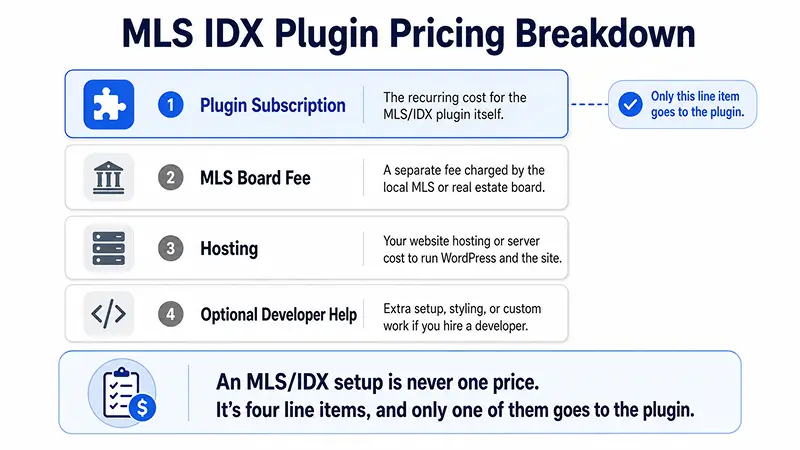
An MLS/IDX setup has four distinct cost components, and only one of them goes to the plugin vendor. That single fact trips up more first-time buyers than anything else. You see “$49/month” on a pricing page, sign up, and then the MLS board sends you a separate bill. That’s not a hidden fee. It’s just a fee that was never the plugin’s to charge in the first place. Take a breath here, because none of this means you’re getting fleeced; it means you need the full map before you sign, and that’s exactly what you’re about to get.
Here’s how the money actually breaks down.
Bucket 1, the plugin subscription. MLSImport is a flat $49/month per WordPress site. No per-listing charge, no per-board charge, no per-photo charge. Whether you import 50 listings or 50,000, the subscription line stays the same. The only ceiling is your hosting.
Bucket 2, the MLS data-access (board) fee. Most US boards charge roughly $10 to $70/month per feed for a direct data feed, on top of your normal dues. Some Canadian boards add $2 to $15+/month per feed. You pay this directly to your MLS, CREA, or TRREB. MLSImport never collects it and never marks it up.
Bucket 3, hosting. A site running thousands of listings wants managed WordPress or a VPS, roughly $10 to $50/month depending on volume. Cheap shared hosting is fine for a few dozen listings and risky at thousands.
Bucket 4, developer or designer help (optional, one-time). A first-year solo build often budgets a few hundred dollars for setup help: picking a theme, building import tasks, configuring filters. You pay it once, if at all, and the plugin doesn’t charge it.
One more thing to keep straight: your association, CREA, or TRREB dues apply no matter which plugin or IDX you choose. Don’t count them against the plugin.
| Cost Component | Typical Range | Who Collects It | Notes |
|---|---|---|---|
| Plugin subscription (MLSImport) | $49/mo or ~$42/mo annual | MLSImport | Flat; no per-listing fees |
| MLS board data-access fee | $10-$70/mo (US) | Your MLS board | Paid directly; not a plugin markup |
| Hosting (managed WP / VPS) | $10-$50/mo | Your hosting provider | Scales with listing volume |
| Developer / designer help | $0-$500 one-time (optional) | Freelancer / agency | Only if you need custom setup |
| Board / association dues | Varies (existing obligation) | Your board / CREA / TRREB | Same cost regardless of plugin choice |
📌 Pro Tip: Before you sign anything, call your MLS board and ask for the data-access or RESO Web API fee schedule. It’s a separate line item from your dues, and it varies by board. Knowing that one number upfront prevents the single most common budgeting surprise in MLS integrations.
How MLS Plugin Pricing Models Compare
There are three ways MLS and IDX tools price themselves, and they make very different bets about how long you’ll stay a customer. Get the model right and the dollars follow. Get it wrong and you’re paying for the vendor’s business plan instead of your own. If money’s tight this quarter, this is the section that decides whether you write a big cheque now or pay a steady fee you can actually plan around.
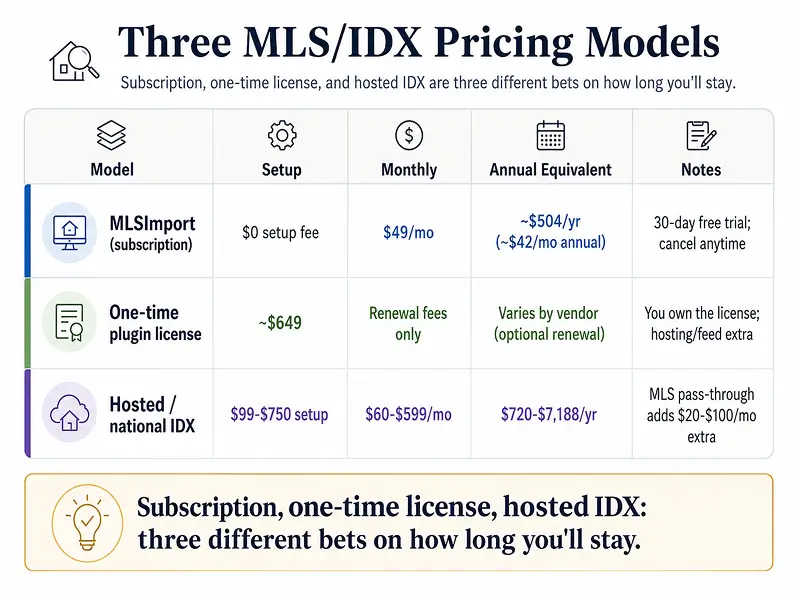
Monthly subscription (the MLSImport model). $49/month, or about $42/month when you pay annually (~$504/year). No setup fee, a 30-day free trial, cancel anytime. The bet here is mutual: low upfront cost, predictable monthly spend, and the vendor has to keep earning your business every month. This is the model that lets you test before you commit, which matters when you’re not yet sure a tool fits your workflow.
One-time / perpetual license (premium plugins). Roughly $649 upfront plus annual renewal fees. If you stay on the same plugin for years, the long-run cost can be lower. But you still pay separately for hosting and your MLS feed, and you carry the upfront cheque. The bet is that you’ll buy once and stick around.
Hosted / national IDX (SaaS IDX providers). $60 to $599/month, with setup fees of $99 to $750 and MLS pass-through add-ons of $20 to $100/month per board. Easiest to switch on, highest ongoing cost. The bet is that convenience keeps you paying indefinitely, because the moment you stop, the listings stop too.
| Pricing Model | Upfront Cost | Monthly Cost | Annual Equivalent | Notes |
|---|---|---|---|---|
| MLSImport (subscription) | $0 setup fee | $49/mo | ~$504/yr (~$42/mo annual) | 30-day free trial; cancel anytime |
| One-time plugin license | ~$649 | Renewal fees only | Varies by vendor (optional renewal) | You own the license; hosting/feed extra |
| Hosted / national IDX | $99-$750 setup | $60-$599/mo | $720-$7,188/yr | MLS pass-through adds $20-$100/mo extra |
Here’s the math that reframes the whole “subscription vs one-time” debate. This is a software-to-software comparison: at $100/month for a hosted IDX versus a $649 one-time plugin, the hosted IDX overtakes the one-time cost around month 7. After that, every month is pure extra spend, and you still don’t own the data. Keep in mind the one-time plugin still needs the same hosting and MLS feed buckets sitting on top of it, exactly as a subscription would, so it’s the recurring software fee, not the total bill, that crosses over here. By year five at $100/month, you’ve handed over roughly $6,000 in subscription alone, before pass-through fees and add-ons even enter the picture.
📌 Pro Tip: Annual billing on MLSImport runs about $504/year versus roughly $588 if you pay monthly across twelve months, so it saves you close to $84/year. Once you’re past the trial and confident the plugin fits, switching to annual is the easiest cost reduction on the table.
The Hidden Costs Nobody Warns You About
The most common complaint about MLS integrations is surprise costs. Here’s the thing: those costs are real. They’re just not going to the plugin vendor. Once you know where each one lands, the budgeting gets simple, and the “gotcha” feeling goes away entirely. Those surprise bills are exactly the thing that keeps you up when you are watching every dollar, so let us drag each one into the light.
The MLS data-access fee (the biggest surprise). US boards commonly charge $10 to $70/month per feed for a direct data feed, and the exact figure varies board by board. Canadian boards can add $2 to $15+/month per feed on some setups. This fee goes straight to your MLS, CREA, or TRREB, and MLSImport never marks it up. It isn’t printed on the plugin’s pricing page for one simple reason: the plugin vendor doesn’t set it. You have to ask your specific board for the number. That’s not the plugin being cagey. That’s just where the fee lives.
Hosting (the most underestimated line item). Cheap shared hosting handles a few dozen listings without complaint. A site importing thousands of properties needs managed WordPress or a VPS, roughly $10 to $50/month. For a large dataset, think a full metro area at 8,000+ properties, plan on PHP memory of 512MB minimum (about 1GB is ideal) and a max execution time near 300 seconds. For perspective, MLSImport has imported around 8,000 properties within a few hours on a mid-range server. The plugin can handle the volume; your host has to be sized for it.
Developer or designer (optional). You don’t need one to get running. But a first-year build often includes a few hundred dollars of one-time setup help, choosing a theme, building import tasks, dialing in filters so you only pull the listings you actually sell. You pay it once, not every month, and only if you want the help.
Board dues (pre-existing). Your association, CREA, or TRREB dues don’t change because you added an IDX. They apply regardless of which plugin or provider you pick, so don’t file them under “plugin cost.”
The cleanest way to think about it: board dues on one side, your MLSImport subscription on the other, with nothing confusing piled on top. No surprise setup fees, no forced add-ons, no long contract. The costs that feel hidden are real, but they’re transparent the moment you know which line item belongs to whom.
TCO Comparison: MLSImport vs Hosted IDX Over 3 to 5 Years
Running the numbers over three years, a WordPress + MLSImport setup all-in typically costs around $3,900, compared with about $4,300 to $5,400 over three years for a comparable hosted IDX subscription (rising toward $9,000 over five years). Be straight with yourself about this part: on raw dollars, the two paths often land close, and a low-tier hosted IDX can even come out ahead at three years. The durable difference isn’t the monthly figure, it’s that when you cancel a hosted IDX you walk away with nothing, and with MLSImport you keep the site. This is the section you came for, so let’s show the full math instead of summarizing it, and let’s itemize both sides so you can actually check it. You’re about to make a multi-year commitment, so it’s worth slowing down for the numbers even if math isn’t your favorite part of the job.
Worked example 1, the $120/month hosted IDX. A hosted IDX at $120/month all-in costs $4,320 over 3 years and $7,200 over 5 years. That’s for access that stops the day you cancel.
Worked example 2, the WordPress + MLSImport 3-year build. Stack it up line by line:
- MLSImport plugin at $49/month = $1,764 over 3 years.
- One MLS feed data-access at about $40/month = $1,440 over 3 years.
- Managed WordPress hosting at about $20/month = $720 over 3 years.
- Total: about $3,924 over 3 years, and you own the WordPress site.
Worked example 3, the 5-year high-end hosted IDX. A hosted IDX at $150/month reaches $9,000 over 5 years. Run the same five years on the WordPress + MLSImport stack from example 2, at about $109/month all-in, and you land near $6,540, while keeping the site as an asset instead of a cancelled subscription. One number to keep straight: the $588/year figure you’ll see quoted is the MLSImport plugin subscription on its own ($49 × 12). The all-in stack, once you add a $40 MLS feed and $20 hosting, runs about $109/month, or roughly $1,308/year. Quote the bucket you actually mean.
| Setup | Monthly All-In (est.) | 3-Year Total | 5-Year Total | You Own the Site? |
|---|---|---|---|---|
| MLSImport + managed WP + $40 MLS feed | ~$109/mo | ~$3,924 | ~$6,540 | Yes |
| Hosted IDX (low tier) | ~$75/mo | ~$2,700 | ~$4,500 | No |
| Hosted IDX (mid tier) | ~$120/mo | ~$4,320 | ~$7,200 | No |
| Hosted IDX (high tier) | ~$150/mo | ~$5,400 | ~$9,000 | No |
What’s inside each “all-in,” so you can check it. The MLSImport row is itemized: $49 plugin + ~$40 MLS board feed + ~$20 hosting = ~$109/month. The hosted IDX rows are the vendor’s blended subscription; the vendor hosts the data, so there’s no separate hosting line on your side. The one line item every option shares is the MLS board data-access fee, the same ~$40/month no matter which tool you pick. MLSImport lists it in the open; with a hosted IDX, confirm whether your board pass-through is already inside the quoted monthly or billed on top (as the pricing-model table above notes, hosted IDX often adds $20 to $100/month for it). If it’s billed on top, add it to both sides equally, it raises the totals but doesn’t change which side wins. When you price your own quote, itemize it the same way before you compare.
Read that table honestly and you’ll notice the low-tier hosted IDX actually looks cheaper at three years. That’s true, and any guide that hides it isn’t being straight with you. The break-even depends heavily on your MLS feed cost: if your board charges $70/month instead of $40, the MLSImport total shifts up. So the dollar figures alone don’t always crown one winner at the three-year mark. The structural difference lives in the last column.
If you want to compare just the software cost, isolated from feed and hosting, the picture is cleaner still. A low-tier hosted IDX runs roughly $840 to $1,200/year, a high-tier one $1,800 to $3,600/year, MLSImport about $504/site/year, and a one-time plugin around $649 upfront plus renewals.
Why the “You Own the Site” Column Matters
When a hosted IDX contract ends, the search widgets typically go dark, the property pages often return 404 errors, and any Google rankings you built on those pages usually evaporate with them. The vendor’s infrastructure was holding it all up, and you were renting that infrastructure month to month. With a WordPress build, the site, the content, the internal links, the backlinks, and the SEO equity are yours. Cancel MLSImport and the listings stop updating; they don’t disappear. That’s the difference between owning an asset and renting access, and it’s why the math favors WordPress even when the monthly numbers look close.
Why Organic Import Changes the Cost Equation
There’s a reason the TCO math favors WordPress + MLSImport even when the monthly numbers look similar: one model builds an asset, and the other rents access. The label for the MLSImport approach is “organic IDX,” and it’s worth understanding what that actually means, because it carries a dollar value. Stick with me here, because this is the quiet difference that decides whether your tech spend builds something you keep.
What organic IDX means. MLSImport calls the RESO Web API for your chosen MLS and imports listings into your own WordPress database as real posts. Each property becomes a crawlable page with its own URL, title tag, and schema markup, living on your domain. Google indexes those pages as yours, because they are.
What hosted IDX does instead. It stores the listing data on the vendor’s servers and renders it into your site through widgets or iframes. Search engines don’t fully treat those pages as yours, because the content belongs to the vendor’s infrastructure, not your domain. You’re displaying their data through a window, not building a library you keep.
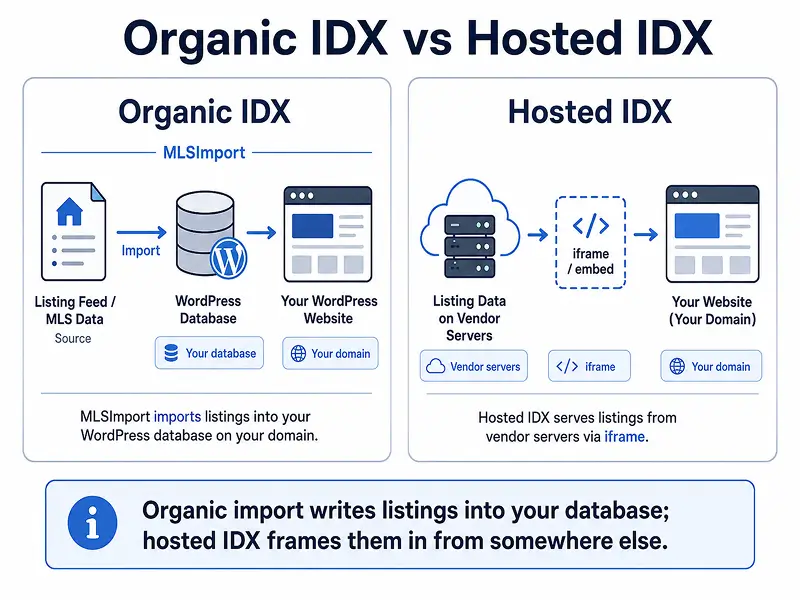
Where your data actually lives. This is the question buyers search for and rarely get answered plainly. With MLSImport, the property text and listing data sit in your WordPress database. Photos are different: they’re served directly from the MLS or its CDN image source, not copied into your media library. That keeps disk usage and backup size small even with thousands of listings, while all the searchable content stays on your domain.
What happens when you cancel. With hosted IDX, cancelling usually pulls the widgets and the content typically vanishes with them. With MLSImport, the listings remain as normal WordPress posts after the subscription ends. They simply stop updating, so to stay MLS-compliant you mark them sold or remove the off-market ones. You’re buying your own asset instead of renting someone else’s, and in this business even one extra closing a year can dwarf the entire tech-spend difference.
📌 Pro Tip: Before you choose any IDX solution, ask one question: “If I cancel tomorrow, what happens to my property pages?” If the answer is “they disappear,” you’re renting, not building. Let that answer factor into every TCO comparison you run.
How the 30-Day Trial Works, and What Happens If You Cancel
The shortest answer to “is it safe to try MLSImport?” is this: 30 days free, full features, $0 until day 31. After that, cancel anytime. No long-term contract, no penalty for leaving. If you’ve ever been burned by a contract you couldn’t get out of, that last part is the one that matters most to you.
Let’s be precise about the terms, because precision is what removes the anxiety. The trial gives you full features at no cost for 30 days, and billing only starts on day 31. From there you’re month-to-month (or annual if you choose), and you can cancel whenever you like with no penalty.
One honest note: there’s no separate money-back guarantee bolted onto the subscription. The trial is the risk-reducer, and it’s built to do that job. Thirty days is long enough to run a real import, test your filters, confirm your MLS feed connects, and verify your hosting handles your listing volume, all before a single dollar leaves your account.
And if you do cancel later? Your imported listings stay in WordPress as normal posts. They stop updating, not disappearing, so you’d mark them sold or remove the off-market ones to stay MLS-compliant. If you were on annual billing, you’ve already paid through the renewal period, so the subscription runs to its end date and then stops. The trade-off is straightforward: annual billing is cheaper per month but less flexible than month-to-month. You pick the one that fits your cash flow.
Agency and Multi-Site Pricing: How Costs Scale
If you manage MLS websites for multiple clients or run separate regional sites, the math is simple: one subscription per live site, at $49/month per site. There’s no volume discount tier to hunt for and no shared license that spans unrelated client domains. One license equals one domain plus one MLS member. If you’re the one signing off on every client’s monthly spend, predictable is exactly what you want, and this model is nothing if not predictable.
That makes scaling linear and easy to forecast. Ten client sites means ten subscriptions at $49/month, so $490/month. On annual billing, that’s ten sites at about $42/month each, roughly $420/month or about $5,040/year. Here’s a detail most agencies miss: each new site gets its own 30-day free trial, and billing starts on day 31 for that specific site. When you’re onboarding clients on different start dates, that staggers your cash flow in your favor.
Covering a second board. MLSImport runs one MLS feed per site per subscription. A single install doesn’t merge two boards into one database. To cover a second board, you spin up a second WordPress site with its own $49/month subscription. Reuse the same theme layouts and cross-link your regional sites so the brand still feels unified across installs. Adding a board is mostly repeating the MLS approval steps and entering new credentials, a config change, not a rebuild.
Off-boarding is graceful. When a client leaves, the agency keeps the license, stops the sync for that non-paying site, and the old content persists as posts. Onboarding works the same way in reverse: each client connects with their own RESO Web API or CREA DDF credentials as a board member, and the legal and account ownership stays with the broker.
Canadian agencies. Same flat $49/month, no Canadian surcharge. Your CREA and TRREB dues stay separate, exactly as they do for a US board.
📌 Pro Tip: If you’re setting up 5+ client sites, switch each one to annual billing as soon as its trial clears. At about $42/month annual versus $49/month monthly, you save roughly $84 per site per year. Across five sites, that’s about $420/year saved just for prepaying.
Frequently Asked Questions
Are there hidden fees beyond MLSImport’s posted $49/month?
Yes, but they don’t go to the plugin vendor. Budget for two additional line items: your MLS board data-access fee ($10 to $70/month in the US, paid directly to your board) and hosting ($10 to $50/month for managed WordPress or a VPS). A one-time, optional developer or setup cost of a few hundred dollars is also common on first builds. MLSImport itself charges no setup fee, no per-listing fee, and no per-board markup.
Over 3 years, is MLSImport really cheaper than a hosted IDX subscription?
It depends on your MLS board fee and hosting costs, and the two often land close, so itemize both quotes before you decide. A WordPress + MLSImport stack with a $40/month MLS feed and $20/month hosting runs about $3,924 over 3 years (that’s $49 plugin + $40 board feed + $20 hosting). A $120/month hosted IDX costs about $4,320 over the same period; just confirm your board’s pass-through fee is inside that monthly or add it to both sides equally. A low-tier hosted IDX can actually be cheaper at three years. The structural edge isn’t the dollar total, it’s that at $150/month a hosted IDX reaches $9,000 over 5 years and leaves you nothing, while the MLSImport site stays yours.
Can one WordPress site pull from more than one MLS feed?
No. MLSImport supports one MLS connection per WordPress site, per subscription. To cover a second board, you set up a second WordPress site with its own $49/month subscription. Agencies and team leads handling multiple regions typically cross-link their regional sites and reuse the same theme templates to keep the brand consistent across installs.
Does MLSImport store my MLS data on its servers or in my WordPress database?
Property text and listing data are stored in your WordPress database, not on MLSImport’s servers. Photos are different: they’re served directly from the MLS or its CDN image source and are not copied into your WordPress media library. This keeps disk usage and backup size small even with thousands of listings, while all the searchable property content lives on your own domain and stays crawlable by Google.
What happens to my listings and SEO if I cancel MLSImport?
Imported listings stay in your WordPress database as normal posts; they don’t disappear when you cancel. They simply stop receiving updates, so no new prices, status changes, or photos come in. To stay MLS-compliant, you’d update them manually or remove the off-market ones. Your SEO equity, the URLs, indexed pages, internal links, and backlinks, stays with your site. That’s the MLSImport model: your content stays put. Compare that to a hosted IDX cancellation, where the widgets typically go dark and the property pages often return 404 errors.
Does MLSImport offer a trial, demo, or money-back guarantee?
MLSImport offers a 30-day free trial with full features: $0 during the trial period, with billing starting on day 31. There’s no money-back guarantee separate from the trial. The trial is designed to be the risk-reducer. It’s long enough to complete a real MLS import, test your filters, and verify that your hosting handles your listing volume before you commit to a paid subscription.
Can one MLSImport license cover multiple client sites for an agency?
No, one license covers one domain. Agencies using MLSImport stack one subscription per live client site. At $49/month per site (or about $42/month on annual billing), managing 10 sites costs roughly $490/month, or about $5,040/year on annual. Each new site gets its own 30-day free trial before billing starts, which helps an agency manage onboarding cash flow across clients running on different start dates.
Which MLS boards and data-access fees should I budget for?
MLSImport supports more than 800 MLS markets and boards across the US and Canada via the RESO Web API, plus CREA DDF in Canada. But board data-access fees are set by each board, not by the plugin. US fees typically run $10 to $70/month per feed. Some Canadian boards add $2 to $15+/month per feed. Contact your specific board’s member services department to confirm the exact data-access fee before you budget.
Does MLSImport charge per listing or per photo?
No. MLSImport is a flat $49/month per WordPress site, with no per-listing, per-board, or per-photo charge. Whether you import 50 listings or 50,000, the subscription line stays exactly the same. The only ceiling on volume is your hosting, not the plugin price.
Is annual billing actually cheaper than paying monthly?
Yes. Annual billing runs about $504/year (roughly $42/month) versus about $588 if you pay monthly across twelve months, so it saves close to $84/year per site. The trade-off is flexibility: month-to-month lets you cancel anytime, while annual locks you in through the renewal date. Once you’re past the trial and confident the plugin fits, switching to annual is the easiest cost reduction available.
Do I need to hire a developer to set up MLSImport?
No, you don’t need one to get running. Many first-year builds budget a few hundred dollars (roughly $0 to $500) for optional, one-time setup help, picking a theme, building import tasks, and dialing in filters so you only pull the listings you actually sell. You pay it once, if at all, and it goes to a freelancer or agency, not to the plugin vendor.
What hosting do I need for thousands of listings?
Cheap shared hosting is fine for a few dozen listings but risky at thousands. A site importing thousands of properties wants managed WordPress or a VPS, roughly $10 to $50/month depending on volume. For a large dataset like a full metro area at 8,000+ properties, plan on PHP memory of 512MB minimum (about 1GB is ideal) and a max execution time near 300 seconds. For perspective, MLSImport has imported around 8,000 properties within a few hours on a mid-range server, so the plugin handles the volume as long as your host is sized for it.
How does a monthly subscription compare to a one-time plugin license?
A one-time or perpetual plugin license runs roughly $649 upfront plus annual renewals, and you still pay separately for hosting and your MLS feed. In a software-to-software comparison, a hosted IDX at $100/month overtakes that $649 one-time cost around month 7, after which every month is pure extra spend. MLSImport’s subscription is $49/month (about $504/year on annual billing), with no upfront cheque and a 30-day free trial, so you can test before committing.
Is there a surcharge for Canadian boards or agencies?
No. MLSImport is the same flat $49/month with no Canadian surcharge, and it connects to CREA DDF in Canada alongside 800+ RESO Web API markets across the US and Canada. Your CREA and TRREB dues, plus any board data-access fee ($2 to $15+/month per feed on some Canadian setups), stay separate and are paid directly to your board, exactly as they would be for a US board.
Ath the end../h2>
You came here for a price, and you’re leaving with something more useful: the ability to read any MLS/IDX quote the way a pro does. Plugin fee, board fee, hosting, and the one question that decides everything, are you renting access or buying an asset? Most agents sign up for a hosted IDX without ever running the three-year math, and they never feel the cost until the day they cancel and watch their property pages typically go dark. You won’t make that mistake now, because you know mls plugin pricing is four buckets, not one number.
So do the practitioner thing today. Start the 30-day MLSImport trial and run a real import. Call your MLS board and ask for the data-access fee schedule. Then rebuild the TCO table above with your own numbers, your feed cost, your hosting, your timeline, and see where the lines cross for you.
What IDX or MLS setup are you running right now, and what does it actually cost you all-in? Drop your number in the comments. It helps your fellow agents calibrate their own budgets.